Wildfire Early Detection System: Environmental Monitoring for Remote Regions
Written by Zak Tresh, Founder & Electronic Engineer, ZTPrototypes · Published 7 August 2026
A Canadian environmental safety organisation asked us to develop a system for monitoring the conditions that precede wildfires in remote areas. The complete system included battery-powered sensor nodes, gateways and a cloud backend, with the hardware expected to run unattended in locations that had no local power or communications infrastructure.
The Challenge
The useful measurements included temperature, humidity and air quality, but collecting them reliably was only part of the problem. The client needed many nodes spread over a large area, each running for long periods from a battery and sending data back through gateways to a central monitoring system. The design therefore had to work as a network, not just as a single sensor on a bench.
The difficult part was keeping that whole chain dependable over months of unattended operation. Sensing, RF performance, power consumption and the backend all had to continue working well enough that the client could trust the data without regularly visiting each node to check it.
Sensor accuracy over time also mattered. In a large deployment, some sensors will drift and batteries will age at different rates. A node producing believable but incorrect values can be harder to spot than one that has stopped reporting completely, so we needed the backend to identify readings that no longer looked consistent with the recent behaviour of that device.
Our Approach
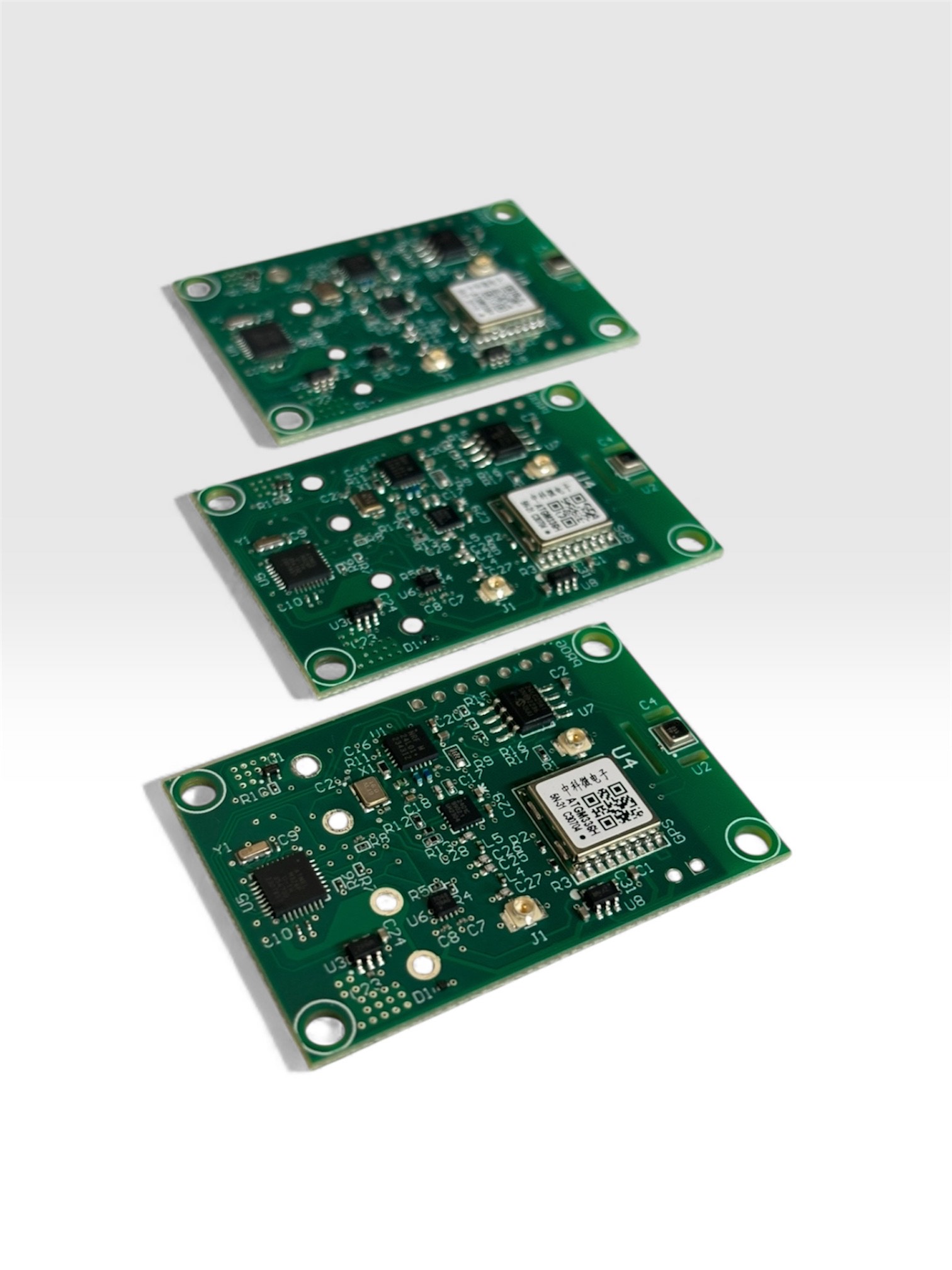
Each sensor node ran from a single 3V battery, so we designed the electronics around low average current from the start. The board also carried separate 2.4 GHz and GPS RF sections. We kept the sensor circuitry away from the noisier parts of the board and paid attention to thermal paths, because electrical noise and self-heating around the sensor can degrade the measurement even when the sensor itself has good specifications.
We built several PCB revisions and compared them directly. Component placement and shielding were changed to reduce interaction between the GPS and wireless sections, then each revision was tested to confirm that the RF performance and measurement quality had actually improved. We did not treat a cleaner-looking layout as evidence on its own.
The cloud backend decodes the incoming payloads and routes the data to the correct part of the monitoring interface. Keeping that logic on the server let the sensor nodes stay simpler and lower power, and it also meant the client could change how data was processed without updating firmware across every unit already deployed in the field.
We added basic anomaly detection to the backend as well. Readings outside plausible limits, or sudden changes that do not fit a node's recent history, can be flagged for review instead of being accepted automatically. That gives the client a way to separate a real environmental change from a failing sensor or a reading affected by a low battery.
Before the wider deployment, we tested how many node connections each gateway could handle reliably and measured power consumption using the same operating patterns expected in the field. Those tests were aimed at the limits of the system, because that is where scaling or battery problems would be most expensive to discover later.
Outcome
The deployed system now gives the client live environmental data from remote areas that were previously unmonitored. The automated alerts are useful because the sensing, communication and backend behaviour were tested together before deployment rather than assuming each part would continue to behave the same way once the network was scaled up.
What This Demonstrates
Remote environmental monitoring has a different failure mode from a connected product sitting in someone's home. If a battery drains early or a wireless link becomes unreliable, there may be nobody nearby to reset the unit or replace it. We therefore treated battery life, RF reliability and measurement noise as basic design requirements because each one directly determines whether the data stream remains usable over a long deployment.
Throughput and power testing against realistic usage gave us evidence that the network could operate at the intended scale before the client committed to the full rollout. The same approach is useful on any IoT project where visiting a failed unit in the field costs far more than finding the problem during development.
The anomaly detection layer in the backend points to a broader principle worth applying to any large sensor deployment. A network of dozens or hundreds of nodes will always include some that drift, degrade, or fail in ways that aren't obvious from a single reading on its own. Building the backend [links to: /services/iot-cloud-backend] to flag suspect data automatically, rather than trusting every reported value equally, is what keeps a large-scale IoT monitoring deployment reliable over time instead of quietly drifting inaccurate without anyone noticing.
Deploying sensors into a remote or unattended environment?
A Validation Sprint identifies power, RF, and reliability risk before you commit to a full field deployment.
Explore the Validation Sprint