Haptic Feedback Wearable: When Enclosure Design Becomes an Antenna Problem
Written by Zak Tresh, Founder & Electronic Engineer, ZTPrototypes · Published 10 April 2026
We developed this wearable system for a sports technology client working with Olympic fencing athletes. The aim was to create wristbands that provide immediate haptic feedback when a fencer is hit or scores a point on their opponent. The behaviour for each event can be configured wirelessly, so for example a hit might produce a solid vibration while scoring a point produces a pulsed pattern. One part of the engineering became particularly important as the wearable got smaller: the enclosure became part of the antenna problem.
The Challenge
The system used a main unit and several body-worn nodes, with the wireless link carrying the haptic commands fast enough that the feedback felt immediate. The wristbands needed to distinguish between different events and reproduce the configured vibration pattern reliably every time. The latency requirement itself was manageable. Fitting the radio and antenna into a small enclosure worn directly against the body was the part that made the design much harder.
Human tissue changes the antenna environment. Bringing an antenna close to the body can detune it, shift the resonant frequency and reduce usable range. In a larger product there may be room to move the antenna or change the ground plane. In this wearable there was very little spare space, so the antenna position and enclosure geometry had to be developed together.
The mechanical design also had to keep that RF geometry stable while the athlete moved. If the PCB or antenna shifted inside the enclosure, the tuning could change. At the same time, the node had to stay small and comfortable enough to wear during competition, so increasing the enclosure size just to make the RF design easier wasn't a useful option.
Our Approach
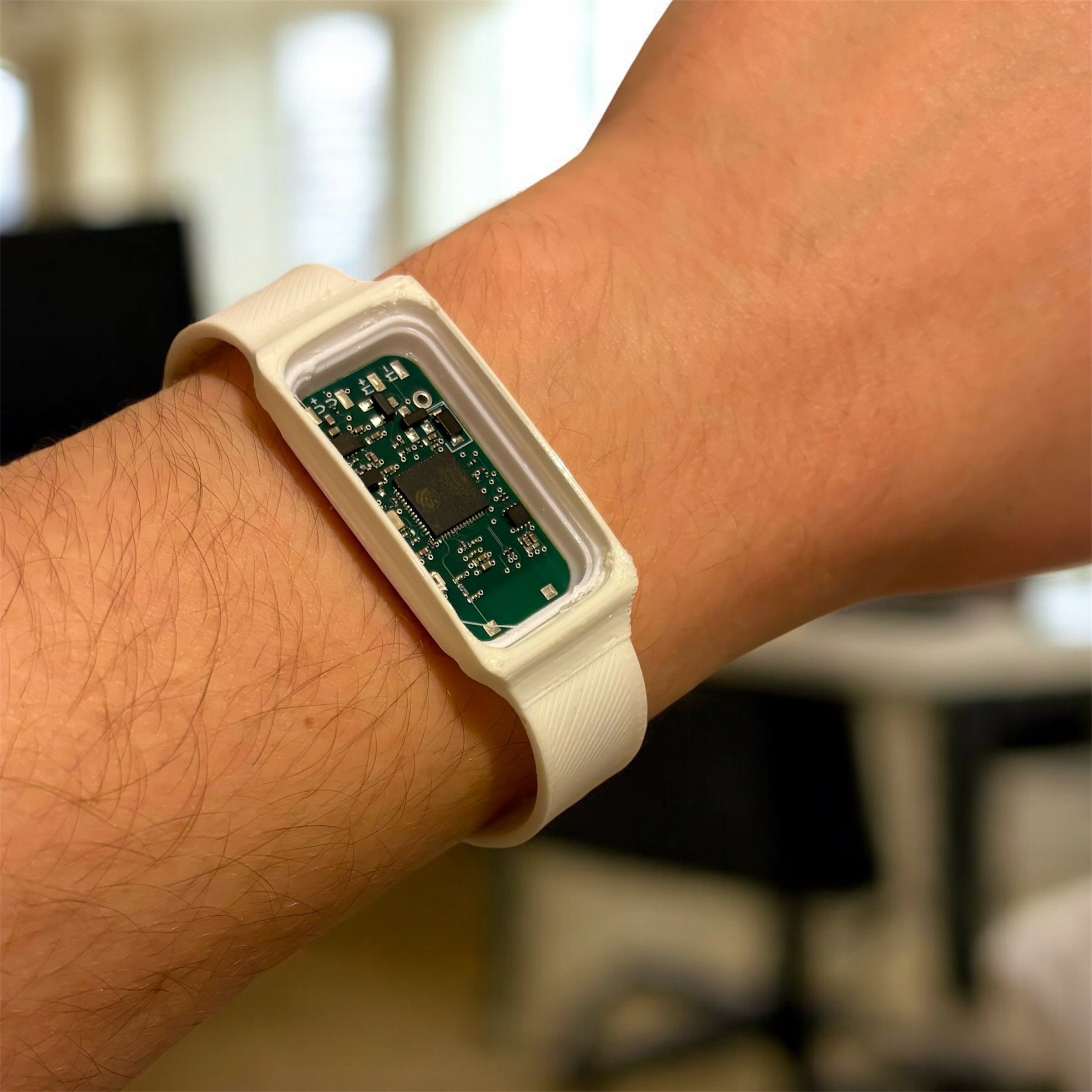
We treated antenna position as one of the enclosure constraints from the first mechanical concepts. We changed the enclosure geometry and antenna placement together, then tested the actual range with the antenna in the position it would occupy while the unit was being worn and moved.
We tried several antenna types and positions and measured link reliability on-body. Each iteration gave us a real result to work from, so we could adjust the geometry and test again. We kept going until the link held consistently across the body positions and movement we expected during use.
The haptic feedback itself gave us a useful acceptance test too. The wristbands could be configured wirelessly with different vibration patterns for different events, such as a solid vibration when the athlete was hit and a pulsed vibration when they scored. If the link dropped a command or added noticeable delay, the athlete could feel it immediately. We therefore tested with athletes during training because that was the environment where the complete system, RF link, movement and haptic timing, could be judged properly.
We also tested the enclosure mechanically before athlete trials. Repeated impact and flexing had to leave the PCB and antenna in the same position and the enclosure intact. There was little value in proving the RF link on a bench if normal use could move the internals enough to change it afterwards.
Outcome
The finished system provides reliable, low-latency haptic feedback in a node small enough to wear comfortably during fencing. The two scoring events can use different, wirelessly configurable vibration patterns, giving the athlete immediate physical feedback without needing to look at another device. We validated the wireless performance under the same on-body movement conditions it would see in use, and the client is now using the completed system as part of an active investment raise.
This was a good example of why compact wearable RF and mechanical design cannot be separated for long. Once the antenna sits close to the body inside a small enclosure, changing the enclosure can change the radio performance and changing the antenna can change the enclosure. We had to solve both at the same time.
What This Demonstrates
Body detuning is easy to miss if a wearable is only tested on a bench. By the time the finished enclosure reveals a range problem, moving the antenna may mean changing the PCB, the enclosure or both. We avoided that by including body proximity and enclosure geometry in the RF work from the first prototypes and measuring the complete worn device throughout development.
The same issue appears in health wearables, industrial safety devices and other compact products worn against the body. It is one of the reasons we include antenna position in the mechanical and enclosure design work early, while there is still room to change the geometry without throwing away a finished design.
There's a validation lesson in how we tested this too. On-body RF performance can't be predicted accurately from free-space measurements or simulation alone. The body's dielectric properties change antenna behaviour, and that varies from person to person and with the position of the device. Testing with real athletes in real training conditions was the only way to confirm the wireless link would hold up where it actually needed to work. We'd take the same approach with any wearable RF product, however good the bench results looked beforehand.
Designing a compact wireless wearable?
A Validation Sprint is where antenna and enclosure trade-offs like these get identified and resolved, before you commit to a full build.
Explore the Validation Sprint