BLE Wellness Ring: Validating a Wearable Concept Before Committing to a Build
Written by Zak Tresh, Founder & Electronic Engineer, ZTPrototypes · Published 9 February 2026
A founder came to us with a compact wellness ring concept using Bluetooth Low Energy, one button for input and LEDs for simple status feedback. The electronics were relatively straightforward. The harder part was fitting the complete system into a ring that could be worn all day while still leaving enough room for a usable battery and a construction that could actually be manufactured.
The founder was not at the point where a physical prototype would answer the most useful questions. They first needed to know whether the architecture made sense, what the likely constraints were and what a realistic build would involve. They also needed something technical they could use in investor conversations. We scoped the work as a Validation Sprint around those questions.
The Challenge
A ring gives you very little space to work with. The MCU, battery, charging circuitry and user interface all have to fit inside a narrow curved volume, and the battery still needs enough capacity for all-day use. This design also needed to flex enough to accommodate different finger sizes, which made the PCB construction an early decision. We needed to work out whether the electronics could stay on rigid sections, whether flex was required, and what each option meant for cost and assembly.
A generic wearable reference design was not enough to answer those questions. The component sizes, power budget and PCB construction all depended on this specific ring geometry, so we needed to analyse them together before any tooling or prototype parts were ordered.
The charging method was a good example of why the form factor mattered. Contacts that work reliably on a flat rigid product can behave differently on a curved surface that is flexed repeatedly. We needed to consider how the chosen charging arrangement would hold up after months of normal wear, as well as whether it could be packaged into the available space on day one.
Why a Validation Sprint, Not a Straight Build
Going straight into a prototype would have locked several assumptions into physical hardware before we had checked them properly. Component selection, battery capacity and the mechanical construction were all still linked. For a founder preparing to raise funding, it made more sense to resolve those questions first and have the reasoning documented before spending the larger build budget.
We therefore scoped a Validation Sprint with a fixed set of engineering outputs. The aim was to define the architecture, parts, power budget, PCB approach and main risks well enough that the founder knew what a build would actually involve before starting one.
What the Sprint Delivered
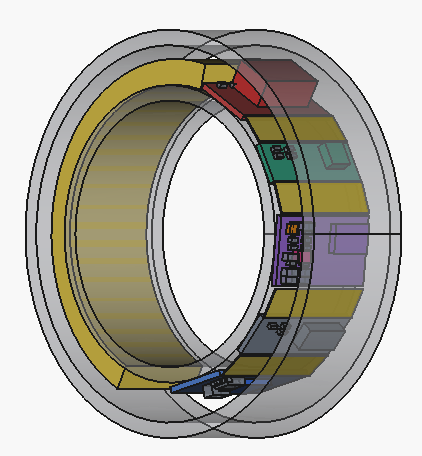
Electrical architecture. We produced a block diagram covering the MCU, BLE radio, charging method and the interfaces between each subsystem inside the ring footprint, which is the architecture shown in the concept render above.
Component selection. We selected specific MCU, power-management and charging parts against the size and power limits of the ring rather than choosing parts from a generic wearable reference design.
Battery selection and power budgeting. We modelled realistic usage states and used that to choose a battery that could plausibly support all-day operation within the available volume.
PCB layout strategy. We worked through the flex versus rigid construction question and mapped the placement constraints against the mechanical design, which resolved the biggest open architecture decision the founder had at the start of the Sprint.
Risk assessment. We documented the main technical risks, including battery life and the manufacturability of the proposed construction, and separated the things we could resolve analytically from the things that would still need to be proven in a physical build.
Outcome
The output was a documented technical foundation the founder could use before committing to a prototype. They are now using the report directly in investor conversations because it shows the architecture, component choices, power assumptions and remaining risks in a form that can be reviewed properly.
That is the useful part of validating this early. Two weeks of engineering work turned a set of assumptions about size, battery life and construction into a specific plan with known open questions before the cost of a full build was on the table.
What This Demonstrates
Wearable feasibility depends heavily on the mechanical form factor. A ring has no generous flat area for a PCB and very little spare volume for the battery, so the electrical architecture, power budget and construction method all affect each other. We treated them as one design problem from the beginning because changing any one of them changes the others.
The deliverables were also chosen with fundraising in mind. The block diagram, component list, power model and risk register are useful engineering documents in their own right, and they are also the sort of material a technical investor or due-diligence engineer can review without needing the founder to translate a vague design idea into engineering terms during the meeting.
For a founder weighing up whether a validation sprint is worth commissioning, this project is a fair example of where it pays off fastest, a compact wearable, real mechanical constraints, a tight timeline, and a genuine need for a defensible answer before more capital gets committed.
Have a concept that needs the same clarity?
If you're at the stage of having a hardware idea and genuine open questions about what it will take to build it, the Validation Sprint is built to answer exactly that, in a fixed two week engagement, with the same rigour this founder's ring project received.
Explore the Validation Sprint