IoT products usually become difficult when the number of devices starts to grow. A single sensor sending data to a simple dashboard is fairly easy to manage. Once you have hundreds or thousands of devices in the field, you also have device provisioning, user accounts, firmware versions, data storage, network failures and ongoing backend cost to think about. The architecture needs to allow for that growth from the start. The three things we normally pay closest attention to are scalability, flexibility and cost, because decisions made early in those areas are difficult to change once a fleet of devices is already deployed.
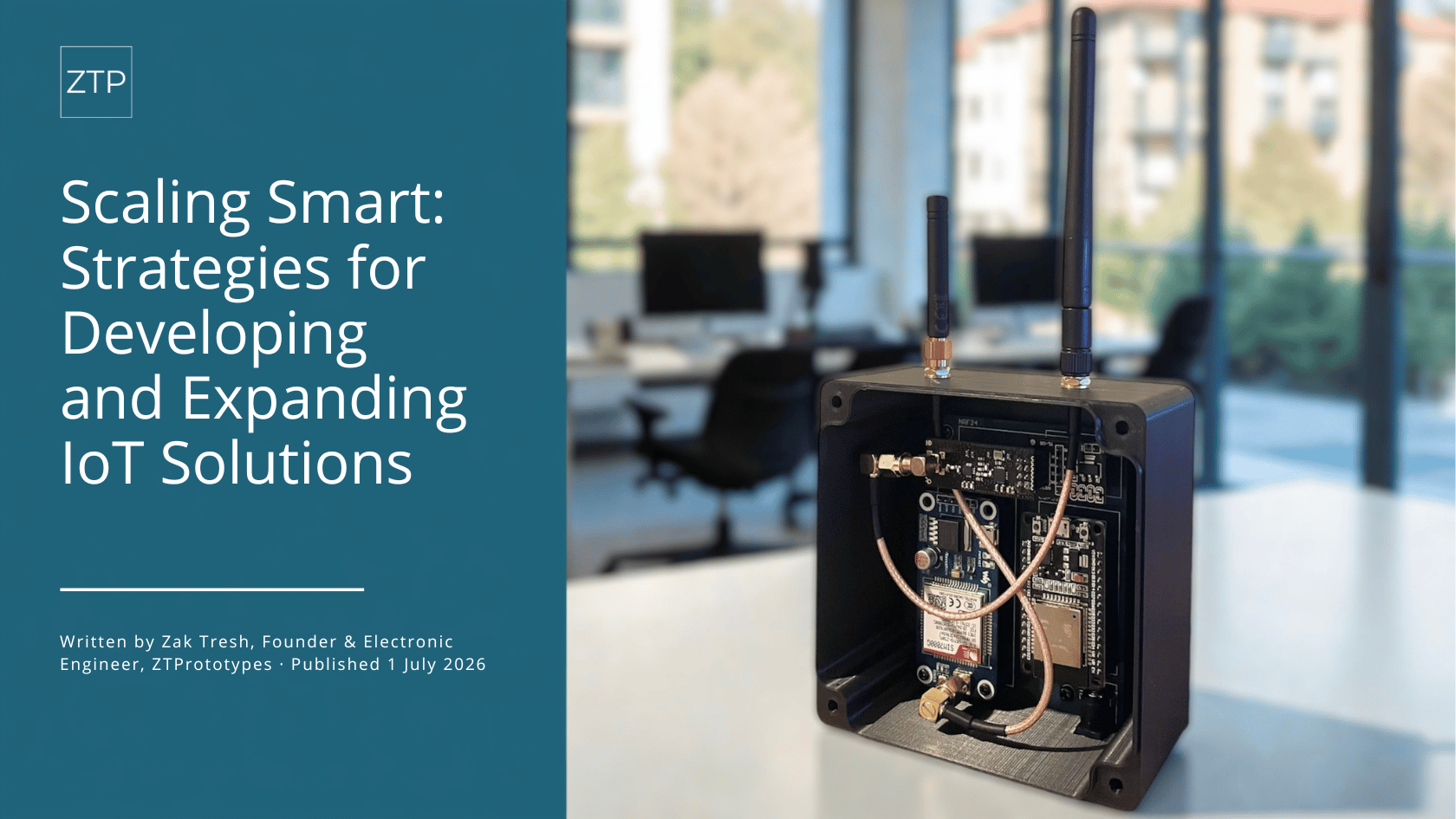
At ZTPrototypes, we've built complete IoT systems for several different applications, including wildfire monitoring in North America and automated irrigation systems used in Africa and Europe. The end products were different, but the underlying structure was similar: sensor or control hardware in the field, a reliable communication link, a backend that receives and stores the data, and software for users to manage devices and view what is happening. Building those parts as separate, well-defined blocks has been useful throughout development. It lets us prove one part of the system without waiting for everything else, and it gives the client room to add new hardware, change how data is processed, or update the user-facing software later without redesigning the whole network. On the wildfire project, for example, remote sensors had to get small packets of data back from areas with limited conventional coverage, while the irrigation system had to receive commands as well as report its own state. Those differences change the radio and device behaviour, but the backend still benefits from the same separation between device communication, storage and user-facing software.
Scalability
Scalability is easiest to deal with before you need it. A backend that works comfortably with twenty devices can behave very differently when twenty thousand devices are posting data, reconnecting after an outage, or requesting updates at the same time. We generally separate the backend into smaller services with clear responsibilities, for example device authentication, data ingestion, storage, alerts and user management. That makes it possible to scale the busy parts independently instead of making the entire system larger every time one service reaches its limit. Cloud infrastructure can help here because compute and storage can be increased as demand grows, and it avoids buying servers for a fleet size you may not reach for several years. The important part is still the architecture. Moving a poorly structured backend onto a larger cloud server only gives the same problems more resources to consume. It is also worth thinking about failure behaviour at this point. If ten thousand devices reconnect after a network outage, the backend may see a short burst far above its normal traffic. Queues, rate limits and retry behaviour need to cope with that without every device making the problem worse at the same time.
Flexibility
Flexibility matters because an IoT product rarely stays exactly as it was on the first prototype. A client might start with one sensor and later add two more, change from WiFi to cellular for a second market, or decide that some data should be processed locally instead of sent to the cloud. We try to keep those options open by using modular hardware interfaces, well-defined APIs and communication protocols that can be supported by more than one device type. Open standards are useful where they make sense because they reduce the amount of custom integration work needed when another sensor, gateway or software service is added later. We also try to keep the messages between devices and backend versioned and backwards-compatible where possible. Field hardware can remain installed for years, so a cloud update should not force every older unit to be upgraded on the same day just to keep basic communication working.
The same applies to the software around the devices. We often build the provisioning, user-account and data-flow software specifically for the product so the client controls how devices are registered, who can access them, what data gets stored and where it goes next. That has been particularly useful during R&D, when the hardware is still changing. A new revision can be added to the existing system without creating a separate backend every time, and data processing can be changed centrally rather than requiring every deployed unit to be replaced. Our preference is to keep the device protocol simple and put complexity in places that can still be updated easily.
Cost Efficiency
Cost becomes more important as the network grows because small per-device costs get multiplied by the entire fleet. There are two main areas to model early: the hardware cost of each deployed device and the ongoing cost of running the backend. A design that is perfectly reasonable at ten units can become expensive at ten thousand, especially if every device carries a higher-spec radio, processor or sensor than it really needs.
The hardware cost depends heavily on what each node has to do. The number of sensors, required battery life and the communication protocol all affect the BOM, and the network topology matters too. A mesh network gives nodes more responsibility because each one may need to receive and forward traffic for other devices. That can mean more capable radios, more memory, more firmware and more power consumption. A star topology can be much simpler if the application allows it: low-cost sensor nodes only talk to a gateway, while the gateway handles the more expensive connection to the internet. We have used both approaches, and the right one comes down to the deployment rather than which topology sounds more capable on paper.
Backend cost is easier to underestimate because it often starts close to zero during development. There is usually a trade-off between development effort and monthly running cost. A managed third-party IoT platform can be very quick to set up, but the per-device or per-message charges can become significant as a fleet grows. A custom backend takes more work initially, although a small private server running purpose-built software can cost only a few dollars a month while a product is being developed and tested. We have deployed this kind of setup for client systems and then increased the infrastructure as the fleet grew. Our IoT backend development service covers the device APIs, provisioning, data handling and server-side software needed for products where a generic platform does not make sense. Security and maintenance belong in the same cost model. Certificates expire, databases need backups, logs need retaining and server software needs updating. None of those are large jobs on day one, but they become part of operating the product once customers depend on it.
Conclusion
A good IoT architecture should let you add devices without having to redesign the backend every time, change parts of the system without breaking everything around them, and understand what the network will cost when it is ten or a hundred times larger. Scalability, flexibility and cost are connected decisions, so we normally model them together rather than treating them as separate jobs. Getting that structure right early leaves the later development focused on the product and the user experience instead of repeatedly rebuilding the infrastructure underneath it.
Ready to build your IoT solution?
Get in touch today to find out how ZTPrototypes can help with your IoT needs.
Get in Touch