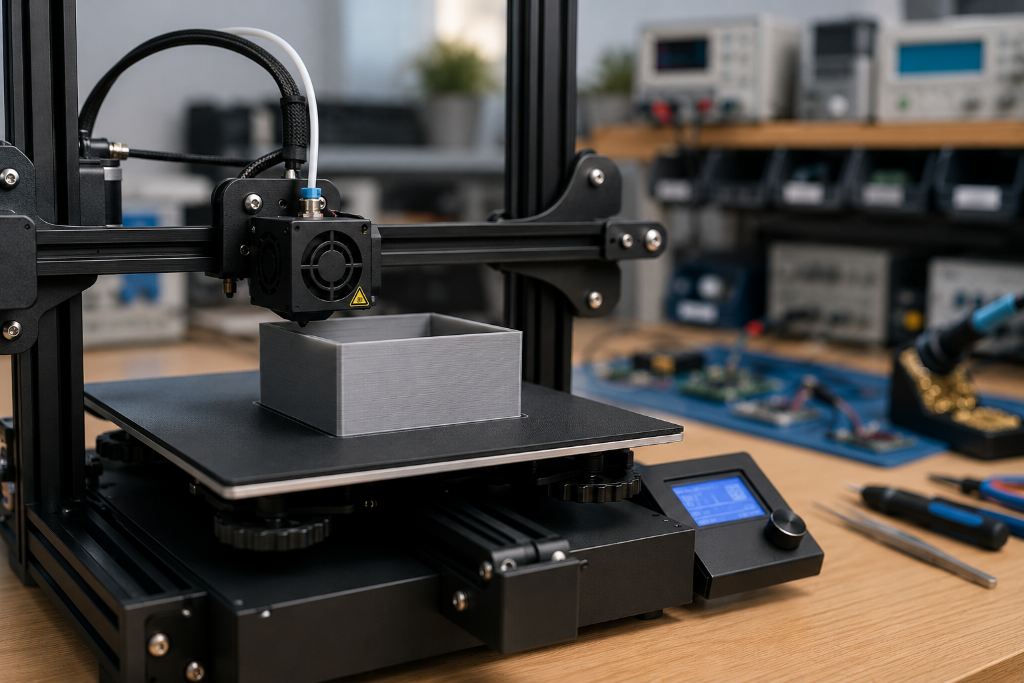
Speed of iteration matters more than perfection at the early stage of a hardware product. The faster you can test a version of an idea, the less time and money you spend building the wrong thing. Rapid prototyping is the general term for the tools and methods that let you do this cheaply, and the mechanical and electronic sides of a product have very different options available right now.
Mechanical rapid prototyping: 3D printing
3D printing has changed how quickly a mechanical idea can be tested. A new enclosure or bracket can be designed, printed, and physically checked against real components within a few hours, rather than the days or weeks a traditional machining or moulding process would take.
A desktop printer, such as a BambuLab A1 or Prusa MK4, costs a few hundred pounds and is capable of producing test-fit enclosures, brackets, and mounts directly from a CAD file. PLA material is fine for most early iterations. PETG or ABS are worth moving to once you need more strength or heat resistance. If you'd rather not own a printer, services like JLC3DP or a local print shop will produce the same parts cheaply and post them to you within a few days.
The real value isn't the printer itself. It's the iteration loop. Print a version, test it against the actual electronics going inside it, adjust the file, print again. Most enclosures need two or three revisions before the fit is right, and each revision costing a few hours and a few pounds in filament, rather than a new tooling charge, is what makes this genuinely useful for a cash-strapped startup.
Electronics rapid prototyping: fast-turn PCB fabrication
The electronics side has improved too, just not as dramatically. PCB fabrication houses like JLCPCB and PCBWay now offer small-batch prototype boards from a few pounds each, with standard fabrication turnaround as fast as 24 to 48 hours and full delivery, including international shipping, typically within a week. That's a genuine change from a decade ago, when a prototype PCB run could take weeks and cost hundreds of pounds.
Where this differs from 3D printing is the loop time. Printing a bracket takes hours because the machine and material are sitting on your desk. Getting a PCB back from a fab house takes days, because there's a manufacturing queue and a shipment involved even at the fastest turnaround. For a startup iterating on a design daily, that gap adds up quickly, and it's the main reason electronics prototyping still lags behind the mechanical side in practice, even though the underlying manufacturing has become genuinely fast and cheap.
Assembly is worth planning for separately from fabrication. Most fab houses offer SMT assembly for an added cost and lead time, which is worth using for fine-pitch parts that are impractical to hand-solder, while hand-soldering the larger, simpler components yourself keeps costs down on an early prototype run.
Closing the gap: CNC-milling copper boards
One option worth knowing about if same-day electronics iteration matters to your project is CNC PCB milling, using a desktop machine such as an LPKF or Bantam Tools to mill the copper traces directly onto a blank board in your own workshop. Rather than waiting on a fab house's queue and shipping, a simple single or double-sided board can go from design file to a physically working prototype within a few hours, similar in spirit to how a 3D printer handles mechanical parts.
The trade-off is capability. Milled boards are generally limited to simpler, lower-density designs than what a professional fab house can etch, and the machines themselves represent a real upfront cost. This makes CNC milling worth considering for a startup that's iterating on electronics daily and can justify the equipment, and not worth it for someone who only needs a handful of prototype runs across a project. Fast-turn fabrication through a service like JLCPCB remains the better default for most early-stage hardware founders.
A practical framework for choosing
For most early hardware prototypes, a sensible approach looks like this: use evaluation boards and breadboard wiring for the electronics while the design is still changing daily, use a desktop 3D printer for the enclosure since iteration is cheap and immediate, and move to a fast-turn PCB fab house once the circuit is stable enough to be worth committing to a physical board. Reach for in-house CNC milling only if you're iterating on electronics often enough, and have the budget, to justify owning the equipment yourself.
When rapid prototyping stops being enough
Rapid prototyping methods are built to answer one question quickly: does this work? They're not built to answer whether it can be manufactured reliably, pass compliance testing, or be produced at any real volume. A 3D-printed enclosure and a hand-assembled prototype board will get you through testing and early investor conversations, but they won't get you to production.
At ZTPrototypes, this is the stage where a proper design pass takes over from the prototyping tools: custom PCB layout designed for manufacture rather than a quick-turn board, an enclosure engineered for injection moulding or another production process rather than 3D printing, and the compliance and regulatory groundwork a real product needs. If you're weighing up whether your prototype is ready for that step, the Validation Sprint is a fixed-price, two-week technical pack covering architecture, bill of materials, cost model, and regulatory pathway, so you know what a full build involves before you commit budget to it.
Ready to take your prototype to production?
Get in touch today to find out how ZT Prototypes can help move your hardware from prototype to production.
Get in Touch